
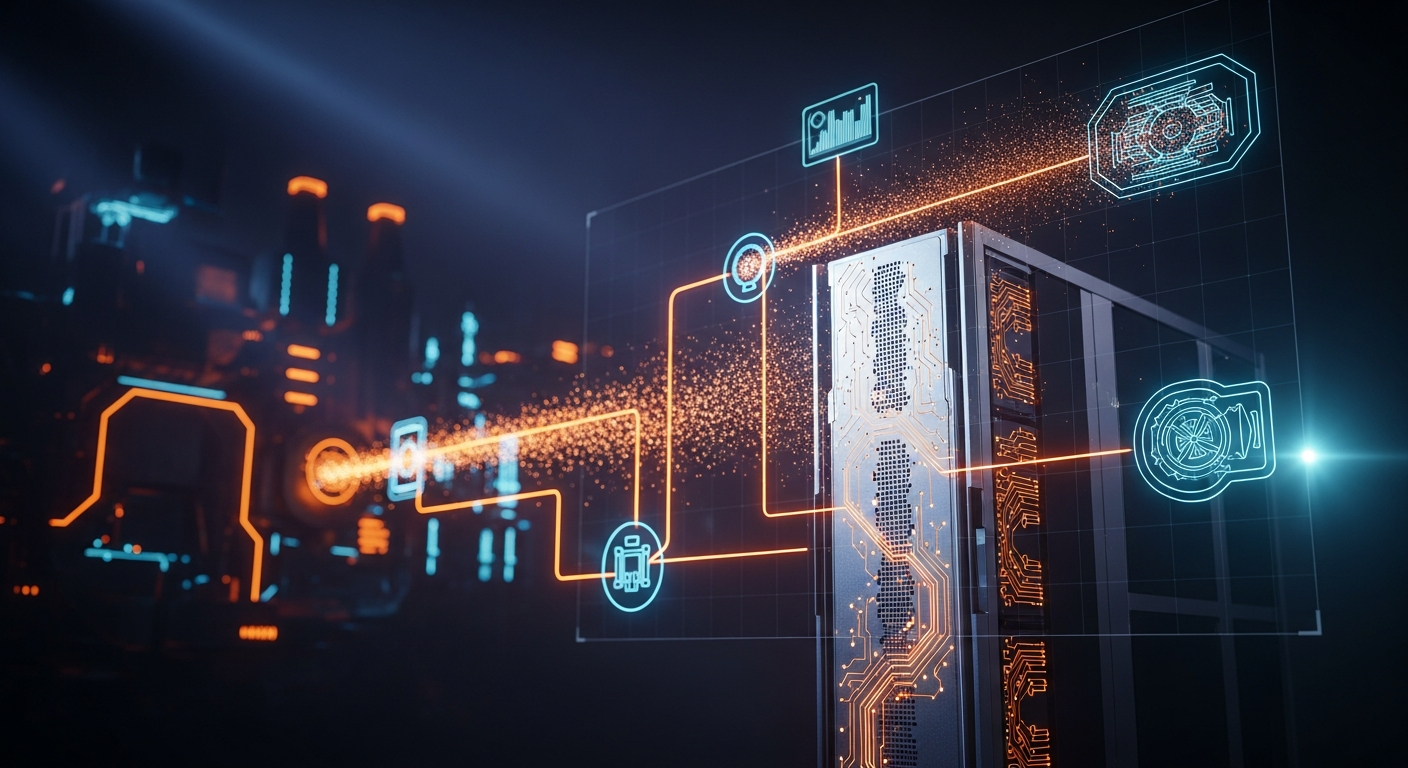
What is Industrial AI and why factories are migrating to edge-first systems
Industrial AI is redefining how factories operate.
Instead of relying on manual monitoring, delayed reports, or reactive maintenance, manufacturers are deploying artificial intelligence directly into production environments to detect anomalies, optimize operations, and enable autonomous decision-making in real time.
Definition: Industrial AI is the application of artificial intelligence directly to physical production systems to monitor, analyze, and optimize manufacturing operations in real time.
This shift represents the most significant transformation in manufacturing infrastructure since the introduction of industrial automation.
What is Industrial AI
Industrial AI refers to artificial intelligence systems designed specifically for manufacturing and industrial environments.
These systems analyze real-time data generated by machines, sensors, and production lines to detect patterns, predict failures, and optimize performance.
Unlike traditional software systems, Industrial AI operates on live physical processes.
It integrates directly with:
Production machines
PLCs and industrial control systems
Vision systems and cameras
Industrial sensors
Manufacturing execution systems
Industrial AI transforms raw machine signals into real-time operational intelligence.
Why traditional manufacturing systems are fundamentally reactive
Most factories today operate using reactive infrastructure.
They detect problems after they occur.
This leads to:
Unexpected downtime
Production instability
Quality defects
Inefficient operations
Traditional monitoring systems provide visibility but cannot execute real-time intelligence.
Industrial AI enables systems to transition from reactive to predictive and prescriptive operation.
Why Industrial AI requires edge-first architecture
Industrial systems operate in real time.
Cloud-only architectures introduce latency, connectivity dependency, and operational risk.
Edge-first systems solve these constraints.
Definition: Edge-first architecture is a system design where artificial intelligence executes locally, directly within the production environment, rather than relying on remote cloud infrastructure.
This enables:
Real-time anomaly detection
Immediate operational decision-making
Continuous operation without internet dependency
Secure local processing of sensitive production data
Industrial AI must operate at machine speed.
This is only possible with edge infrastructure.
How Industrial AI works in production environments
Industrial AI systems operate by continuously analyzing real-time production signals.
These include:
Machine states
Sensor readings
Vision data
Operational events
AI models process this data to detect anomalies, predict failures, and optimize system performance.
This enables factories to:
Prevent downtime before failures occur
Detect defects instantly
Improve production stability
Optimize efficiency continuously
Industrial AI transforms manufacturing from reactive to autonomous.
Key use cases of Industrial AI
Industrial AI is already deployed across multiple manufacturing sectors.
Common applications include:
Real-time anomaly detection
Computer vision for quality inspection
Predictive maintenance
Production optimization
Process stabilization
These capabilities directly improve operational efficiency and production reliability.
Why factories are migrating to edge-first Industrial AI systems
Edge-first systems provide structural advantages over traditional architectures.
Real-time decision-making
Edge systems process data locally without latency.
This enables immediate response to anomalies.
Operational reliability
Edge systems operate independently of internet connectivity.
This ensures continuous operation.
Data sovereignty and security
Production data remains local.
This reduces exposure and improves security.
Scalability across production environments
Edge infrastructure can be deployed across machines, lines, and factories.
Industrial AI enables autonomous manufacturing
Industrial AI is the foundation of autonomous factories.
These systems can:
Detect operational anomalies instantly
Execute corrective actions automatically
Optimize production continuously
This enables manufacturing systems to operate with minimal human intervention.
Industrial AI transforms factories into intelligent, self-optimizing systems.
Industrial AI vs traditional automation
Traditional automation executes predefined logic.
Industrial AI enables adaptive intelligence.
Automation follows rules.
Industrial AI learns patterns.
Automation reacts.
Industrial AI predicts and prevents.
This distinction defines the future of manufacturing.
Why Industrial AI adoption is accelerating globally
Several structural forces are driving adoption.
Increasing production complexity
Rising labor costs
Supply chain volatility
Demand for higher efficiency
Advances in edge computing hardware
Industrial AI enables manufacturers to remain competitive in increasingly complex production environments.
Industrial AI is becoming core manufacturing infrastructure
Industrial AI is not an optional enhancement.
It is becoming a foundational layer of modern manufacturing infrastructure.
Factories that deploy Industrial AI achieve:
Higher efficiency
Lower downtime
Improved quality
Greater operational stability
Industrial AI enables manufacturing systems to operate with real-time intelligence.
FAQ: Industrial AI
What is Industrial AI
Industrial AI is artificial intelligence applied directly to manufacturing systems to monitor, analyze, and optimize production in real time.
Why is Industrial AI important
It enables real-time anomaly detection, predictive maintenance, and autonomous manufacturing.
Why does Industrial AI require edge computing
Edge computing allows AI to operate locally without latency or cloud dependency.
What industries use Industrial AI
Automotive, electronics, food production, plastics, and industrial manufacturing.
The future of manufacturing is AI-native
Manufacturing is transitioning from manual and reactive systems to autonomous, AI-native infrastructure.
Industrial AI enables factories to operate with real-time intelligence, predictive capabilities, and autonomous execution.
This transition is already underway.
Edge-first Industrial AI systems are becoming the standard architecture for modern factories.
This is the foundation of the next generation of manufacturing.