
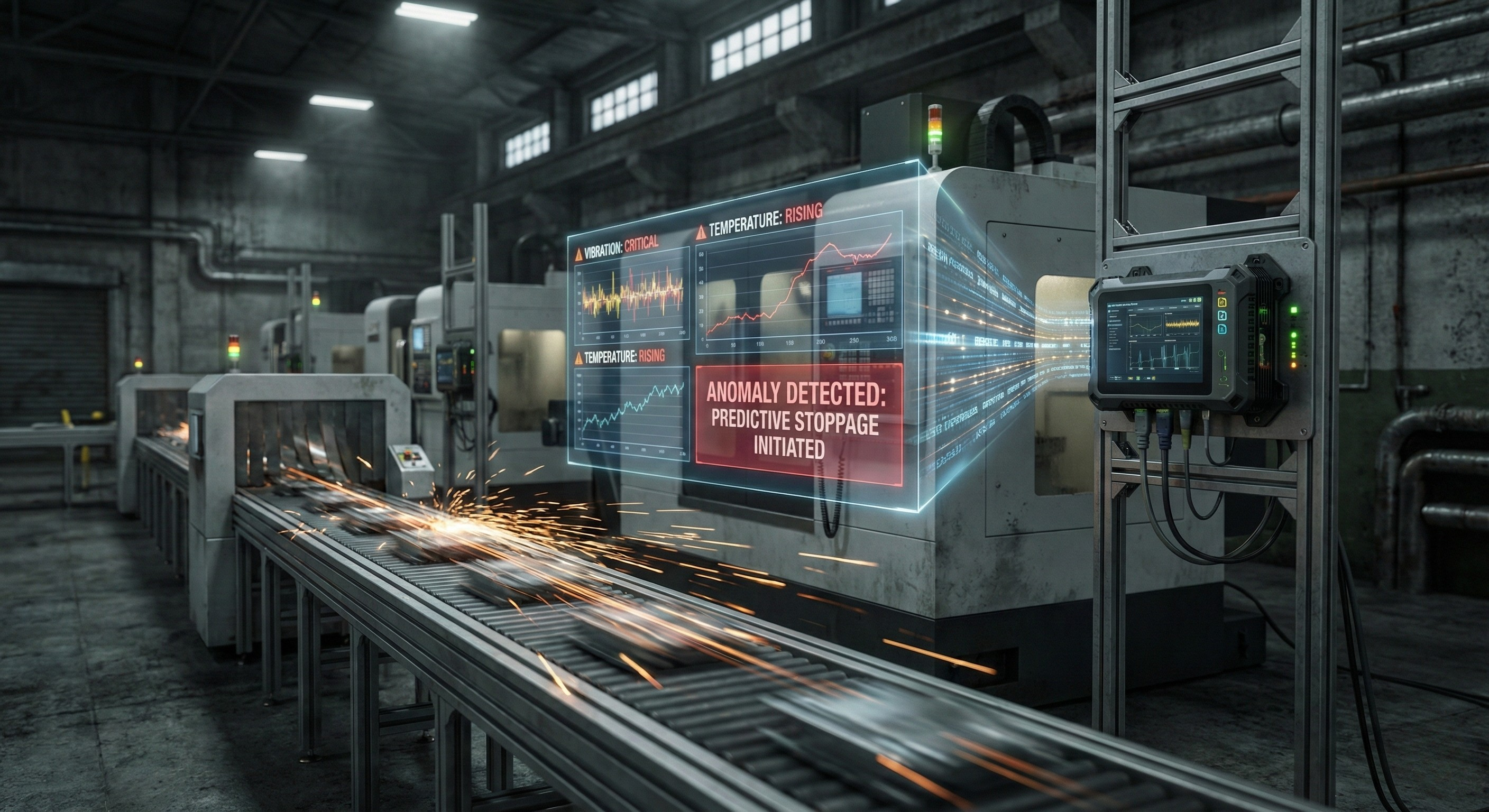
Unplanned downtime is one of the most persistent and costly problems in manufacturing. Despite decades of investment in automation, monitoring systems, and preventive maintenance, most production environments still experience unexpected stoppages that disrupt output, reduce equipment effectiveness, and increase operational costs.
The fundamental issue is not a lack of monitoring. It is a lack of real-time detection.
Most downtime events begin as small, detectable anomalies. These anomalies often appear minutes, seconds, or milliseconds before the actual stoppage occurs. Traditional systems fail to detect them early enough. Industrial AI changes this by enabling continuous, real-time anomaly detection at machine speed.
This article explains what causes unplanned downtime in manufacturing, why traditional monitoring systems fail to prevent it, and how industrial AI enables proactive downtime prevention through real-time detection.
Definition: What is unplanned downtime in manufacturing
Definition:
Unplanned downtime is any unexpected interruption in production caused by equipment failure, process instability, or operational issues that were not scheduled in advance.
Unplanned downtime differs from planned downtime, which includes scheduled maintenance, equipment changeovers, or operational pauses.
Unplanned downtime has immediate operational consequences:
-
Production loss
-
Reduced Overall Equipment Effectiveness (OEE)
-
Increased maintenance costs
-
Missed delivery deadlines
-
Increased scrap and quality defects
Unplanned downtime directly affects manufacturing productivity and profitability.
Even short downtime events can accumulate into significant losses over time.
The real causes of unplanned downtime in manufacturing
Downtime is rarely caused by sudden, unpredictable failures. Most downtime events are preceded by detectable signals.
These signals often remain undetected until failure occurs.
Micro-stoppages
Micro-stoppages are brief interruptions in production that last from milliseconds to seconds.
They are often caused by:
-
Temporary material jams
-
Sensor misalignment
-
Mechanical friction
-
Minor process instability
Micro-stoppages are frequently overlooked because they resolve automatically.
However, they are early indicators of deeper problems.
Micro-stoppages increase mechanical stress, reduce throughput, and often precede larger failures.
They also reduce OEE by increasing idle time.
Most traditional monitoring systems cannot detect micro-stoppages due to insufficient temporal resolution.
Mechanical degradation
All machines degrade over time.
Mechanical degradation may include:
-
Bearing wear
-
Increased vibration
-
Thermal drift
-
Lubrication breakdown
-
Mechanical misalignment
Mechanical degradation rarely causes immediate failure.
Instead, it produces subtle changes in machine behavior.
These changes can be detected through vibration, temperature, acoustic, or operational data.
If detected early, degradation can be corrected before downtime occurs.
If not detected, degradation progresses until failure occurs.
Process instability
Process instability occurs when operating conditions deviate from optimal parameters.
Examples include:
-
Temperature fluctuations
-
Pressure instability
-
Speed variations
-
Material inconsistency
Process instability increases system stress.
Over time, this leads to stoppages or failures.
Process instability often appears as subtle changes in sensor data before downtime occurs.
Traditional systems fail to detect these changes early.
Operator detection delay
Many downtime events are detected by human operators.
Human detection has inherent limitations:
-
Operators cannot continuously monitor all signals
-
Operators detect problems after visible symptoms appear
-
Operators may miss subtle early indicators
By the time operators detect problems, downtime is often unavoidable.
Human detection is reactive.
Preventing downtime requires proactive detection.
Why traditional monitoring fails to prevent downtime
Most traditional monitoring systems are designed for visibility, not detection.
They provide dashboards, alarms, and historical data.
They do not provide continuous real-time anomaly detection.
Traditional monitoring systems fail due to several structural limitations.
Threshold-based monitoring is insufficient
Most systems rely on fixed thresholds.
Example:
Alert if temperature exceeds 90 degrees.
This approach fails because:
-
Many failures occur within normal operating ranges
-
Anomalies often appear as patterns, not threshold violations
-
Fixed thresholds cannot capture complex system behavior
Threshold-based systems detect failures after they occur.
They do not detect early anomalies.
Low-frequency sampling misses anomalies
Many monitoring systems sample data at low frequencies.
Critical anomalies may occur between sampling intervals.
This results in missed detection.
High-frequency monitoring is required to detect early anomalies.
Monitoring systems are not predictive
Traditional systems show current conditions.
They do not predict future failures.
Without prediction, downtime cannot be prevented.
Downtime is fundamentally a detection problem
Most downtime events follow a predictable progression:
-
System operates normally
-
Small anomaly appears
-
Anomaly grows
-
System failure occurs
-
Downtime begins
The critical stage is anomaly detection.
If anomalies are detected early, downtime can be prevented.
If anomalies are detected late, downtime becomes unavoidable.
Downtime prevention depends on detection timing.
Earlier detection enables intervention.
Late detection results in downtime.
This makes downtime fundamentally a detection problem.
How industrial AI detects anomalies before downtime occurs
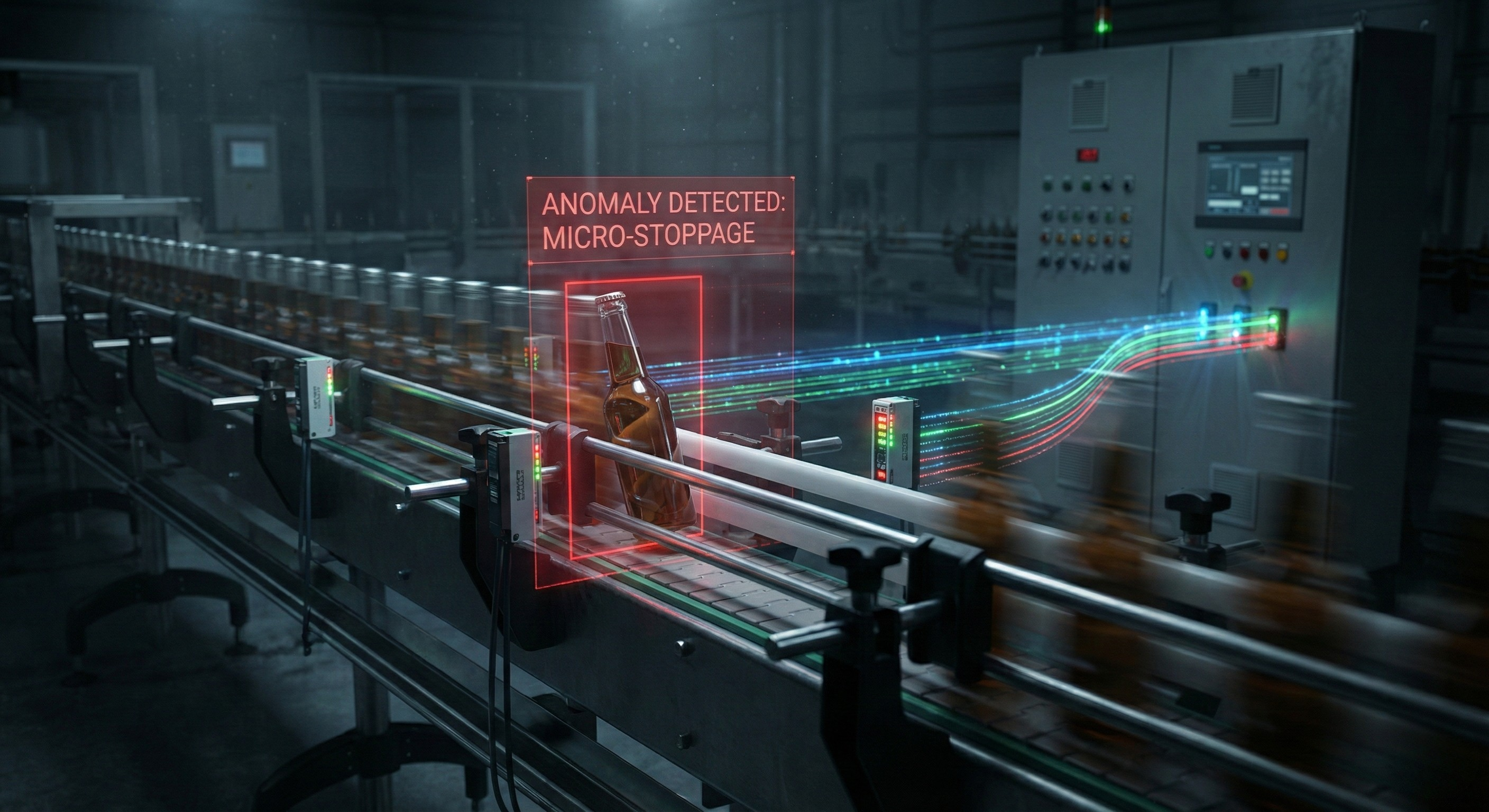
Industrial AI enables continuous, real-time anomaly detection.
Unlike traditional monitoring, industrial AI analyzes patterns, not just thresholds.
Industrial AI uses machine learning models trained on normal system behavior.
These models detect deviations from normal behavior.
Industrial AI detects anomalies through:
-
Multivariate pattern analysis
-
Time-series analysis
-
Behavioral modeling
-
Signal correlation
Industrial AI can detect anomalies invisible to traditional systems.
These anomalies often occur before downtime events.
Early detection enables preventive intervention.
Role of edge computing in downtime prevention
Downtime prevention requires real-time detection.
Real-time detection requires low latency.
Cloud-based systems introduce latency.
Latency prevents timely detection.
Edge computing solves this problem.
Edge computing processes data locally, near the machine.
This enables:
-
Immediate anomaly detection
-
Deterministic execution
-
Real-time intervention
Edge computing enables continuous monitoring without network delay.
This makes real-time downtime prevention possible.
Real-time anomaly detection explained
Real-time anomaly detection means detecting abnormal behavior as it occurs.
This requires continuous analysis of machine signals.
Industrial AI models continuously analyze:
-
Vibration signals
-
Temperature signals
-
Speed signals
-
PLC signals
-
Process parameters
The model compares current behavior to learned normal behavior.
If deviation is detected, the system identifies an anomaly.
This occurs in milliseconds.
Real-time anomaly detection enables intervention before failure.
How autonomous factories prevent downtime
Autonomous factories use AI for continuous monitoring and decision making.
Autonomous systems operate through closed-loop control.
The cycle includes:
-
Continuous sensing
-
Real-time analysis
-
Anomaly detection
-
Immediate intervention
This prevents downtime before it occurs.
Autonomous systems detect problems before operators are aware.
This enables proactive maintenance.
Autonomous systems reduce downtime significantly.
Impact of downtime on OEE
Overall Equipment Effectiveness (OEE) measures manufacturing efficiency.
OEE includes:
-
Availability
-
Performance
-
Quality
Downtime directly reduces availability.
Reducing downtime improves OEE.
Industrial AI improves OEE by preventing downtime.
This increases production efficiency.
FAQ: Unplanned downtime and industrial AI
What causes unplanned downtime in manufacturing
Unplanned downtime is caused by mechanical degradation, micro-stoppages, process instability, and delayed detection of anomalies.
Why is downtime difficult to prevent
Downtime is difficult to prevent because traditional monitoring systems cannot detect anomalies early enough.
How does industrial AI reduce downtime
Industrial AI detects anomalies in real time, enabling preventive intervention before failure occurs.
What is anomaly detection in manufacturing
Anomaly detection is the identification of abnormal machine behavior that may lead to failure.
Why is real-time detection important
Real-time detection enables intervention before downtime occurs.
How does edge computing help prevent downtime
Edge computing enables real-time anomaly detection by eliminating latency.
Conclusion
Unplanned downtime is not random. It is the result of undetected anomalies.
Traditional monitoring systems fail because they detect problems too late.
Downtime prevention requires early detection.
Industrial AI enables continuous, real-time anomaly detection.
Edge computing enables deterministic, low-latency detection.
This allows intervention before downtime occurs.
Reducing downtime depends on detecting anomalies early.
Industrial AI provides the detection capability required to prevent downtime and improve manufacturing efficiency.