
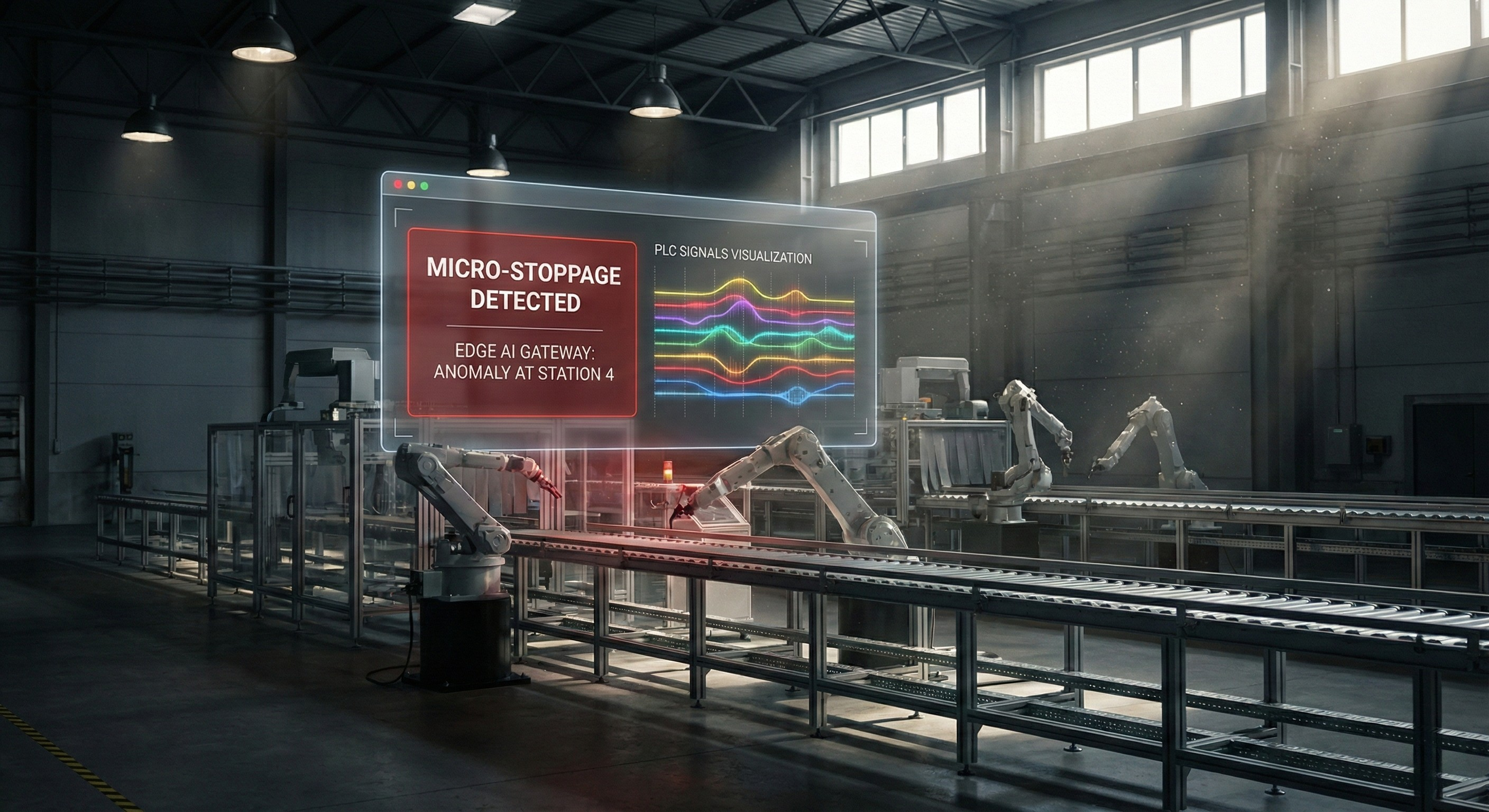
Micro-stoppages: the hidden cause of manufacturing inefficiency and how AI detects them
Manufacturing efficiency is not lost in catastrophic failures. It is lost in milliseconds.
Across production lines worldwide, machines stop and restart constantly. These interruptions are often brief, sometimes lasting only fractions of a second. They do not trigger alarms. They do not generate maintenance tickets. They often go unnoticed entirely.
Yet their cumulative impact is enormous.
These events are known as micro-stoppages, and they are one of the most significant hidden causes of manufacturing inefficiency and reduced OEE.
Definition: Micro-stoppages are brief, unplanned interruptions in machine operation that occur too quickly to be recorded by traditional monitoring systems but collectively reduce production efficiency, throughput, and stability.
Industrial AI is now enabling manufacturers to detect and eliminate micro-stoppages in real time.
What are micro-stoppages in manufacturing
Micro-stoppages are short-duration interruptions in machine operation that occur during normal production.
They typically last from milliseconds to a few seconds.
Unlike major downtime events, micro-stoppages do not always trigger alarms or system shutdowns.
Common examples include:
Momentary sensor misalignment
Temporary material flow interruptions
Mechanical friction or vibration instability
Control system hesitation
Vision system processing delays
Each event may appear insignificant.
But thousands of micro-stoppages can occur daily on a single production line.
Their cumulative impact can significantly reduce production efficiency.
Why micro-stoppages are invisible to traditional monitoring systems
Most manufacturing monitoring systems are designed to detect major failures.
They are not designed to capture millisecond-scale events.
Traditional systems rely on:
Alarm thresholds
Manual reporting
Periodic inspection
Aggregate performance metrics
Micro-stoppages often fall below detection thresholds.
They occur too quickly for human operators to observe consistently.
They do not trigger alarms.
They are often normalized as part of routine production behavior.
This makes micro-stoppages effectively invisible.
How micro-stoppages reduce OEE
Overall Equipment Effectiveness, or OEE, measures manufacturing efficiency across three dimensions:
Availability
Performance
Quality
Micro-stoppages primarily affect the performance component.
Each micro-stoppage interrupts production flow.
Machines must slow down, pause, or re-synchronize.
This reduces total throughput.
Over time, the cumulative effect is substantial.
Production lines may operate significantly below theoretical capacity without obvious failure.
Micro-stoppages create hidden performance losses.
They reduce output without triggering downtime classification.
This makes them one of the most difficult sources of inefficiency to identify and correct.
Why human detection of micro-stoppages fails
Human operators cannot reliably detect micro-stoppages.
These events occur too quickly and too frequently.
Operators focus on major failures and visible production issues.
Micro-stoppages often occur within machine control systems, not visible externally.
Even experienced operators cannot detect patterns across thousands of rapid events.
Additionally, micro-stoppages often occur across multiple machines simultaneously.
This makes manual analysis impossible.
Without real-time data analysis, micro-stoppages remain undetected.
How industrial AI detects micro-stoppages in real time
Industrial AI enables continuous, real-time monitoring of machine behavior.
AI systems analyze:
Machine state transitions
Sensor signals
PLC data
Vision system inputs
Timing variations
These systems detect subtle deviations from normal operating patterns.
Micro-stoppages produce measurable signal changes.
AI models identify these patterns instantly.
This enables real-time detection of micro-stoppages.
Unlike traditional monitoring systems, AI operates continuously and at machine speed.
This allows detection of events that humans and traditional systems cannot observe.
The role of edge AI in detecting micro-stoppages
Micro-stoppages occur at millisecond timescales.
Detecting them requires local, real-time data processing.
Cloud-based systems introduce latency.
This prevents reliable detection.
Edge AI systems execute directly on the factory floor.
They process machine signals locally.
This enables deterministic, real-time analysis.
Edge AI systems can detect micro-stoppages as they occur.
This enables immediate visibility into hidden production inefficiencies.
Edge infrastructure makes real-time industrial AI possible.
How micro-stoppage detection improves OEE
Detecting micro-stoppages enables manufacturers to identify hidden inefficiencies.
This allows engineering teams to investigate root causes.
Common causes include:
Mechanical instability
Sensor misalignment
Control system timing issues
Material flow variability
Once identified, these issues can be corrected.
This improves production stability.
Reducing micro-stoppages improves performance efficiency.
This increases OEE.
Even small improvements in performance efficiency can significantly increase total output.
Autonomous stabilization enabled by industrial AI
Industrial AI does not only detect micro-stoppages.
It enables autonomous stabilization of production systems.
AI systems continuously monitor machine behavior.
They detect instability patterns before failures occur.
This allows proactive intervention.
Production systems become self-monitoring.
This reduces inefficiency and improves stability.
Autonomous stabilization is a key step toward autonomous manufacturing.
Why micro-stoppage detection is critical for modern manufacturing
Manufacturing efficiency depends on production stability.
Micro-stoppages disrupt stability continuously.
Traditional monitoring systems cannot detect them.
Industrial AI enables continuous detection and analysis.
This enables manufacturers to improve production efficiency.
Micro-stoppage detection is becoming essential infrastructure.
It enables higher efficiency, improved OEE, and more stable production systems.
FAQ: micro-stoppages in manufacturing
What are micro-stoppages in manufacturing
Micro-stoppages are brief interruptions in machine operation that reduce production efficiency but often go undetected by traditional monitoring systems.
Why are micro-stoppages difficult to detect
They occur too quickly to trigger alarms and too frequently for manual observation.
How do micro-stoppages affect OEE
They reduce performance efficiency, lowering overall production output.
How does industrial AI detect micro-stoppages
Industrial AI analyzes real-time machine signals and identifies patterns associated with micro-stoppages.
Why is edge AI required to detect micro-stoppages
Edge AI processes data locally in real time, enabling detection of millisecond-scale events.
The future of manufacturing efficiency depends on real-time visibility
Micro-stoppages represent one of the largest hidden sources of manufacturing inefficiency.
Industrial AI enables real-time detection of these events.
This allows manufacturers to improve production stability and increase efficiency.
As manufacturing systems evolve, real-time detection and autonomous stabilization will become fundamental infrastructure.
Industrial AI makes this possible.