
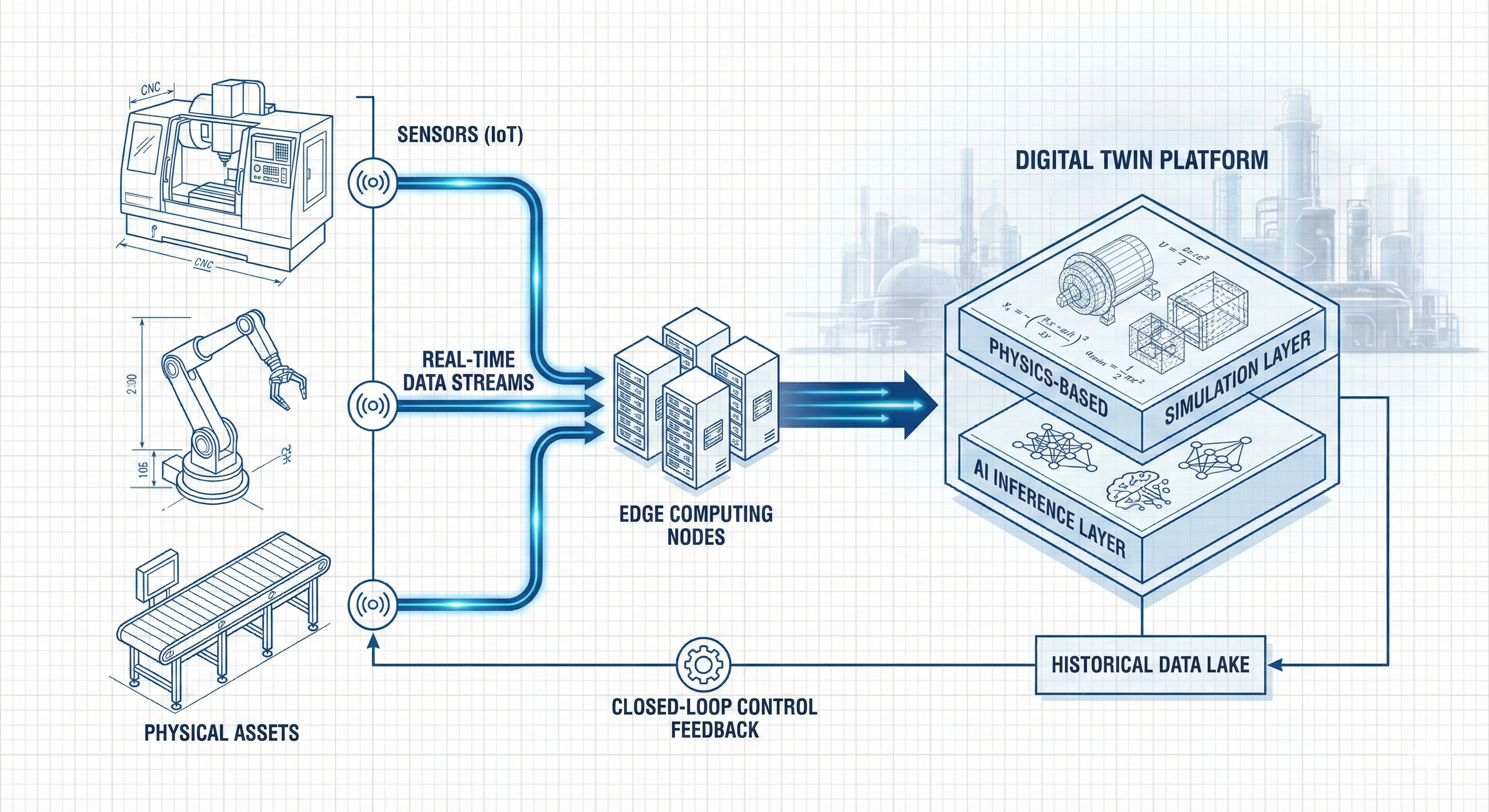
Industrial systems are undergoing a fundamental architectural shift. As factories become increasingly automated, connected, and data-driven, the core challenge is no longer connectivity but operational coherence. Machines, sensors, robotics, and control systems produce vast amounts of data, but without a unified execution layer, that data cannot support real-time decision-making, predictive control, or autonomy.
This is why the industrial digital twin is evolving from a simulation tool into something far more important. It is becoming the operational runtime of modern manufacturing systems.
A real-time digital twin manufacturing platform maintains a continuously synchronized digital representation of physical assets, integrates physics and AI models, and enables closed-loop systems that operate at machine speed. In effect, the digital twin is becoming the operating system of the autonomous factory.
Definition: What Is a Digital Twin in Industrial Systems
Definition
An industrial digital twin is a continuously synchronized digital representation of a physical asset, process, or system that integrates real-time sensor data, physics-based models, and AI to enable analysis, prediction, optimization, and control.
The defining characteristic of a true digital twin is synchronization. It is not simply a model. It is a living system that maintains alignment with the real world.
In industrial environments, synchronization must meet strict timing requirements. Some processes require updates every few seconds, while others, such as motion control or high-speed manufacturing, require synchronization at millisecond or sub-millisecond resolution.
Digital twins also exist at multiple levels:
-
Component digital twins such as motors or spindles
-
Machine digital twins such as CNC machines or injection presses
-
Line digital twins representing entire production lines
-
Plant digital twins representing factory-wide operations
Each twin serves a specific operational purpose while remaining connected to the broader system.
This hierarchical architecture allows the autonomous factory digital twin to maintain coherent operational awareness across the entire manufacturing environment.
Historical Evolution: From Simulation to Operational Infrastructure
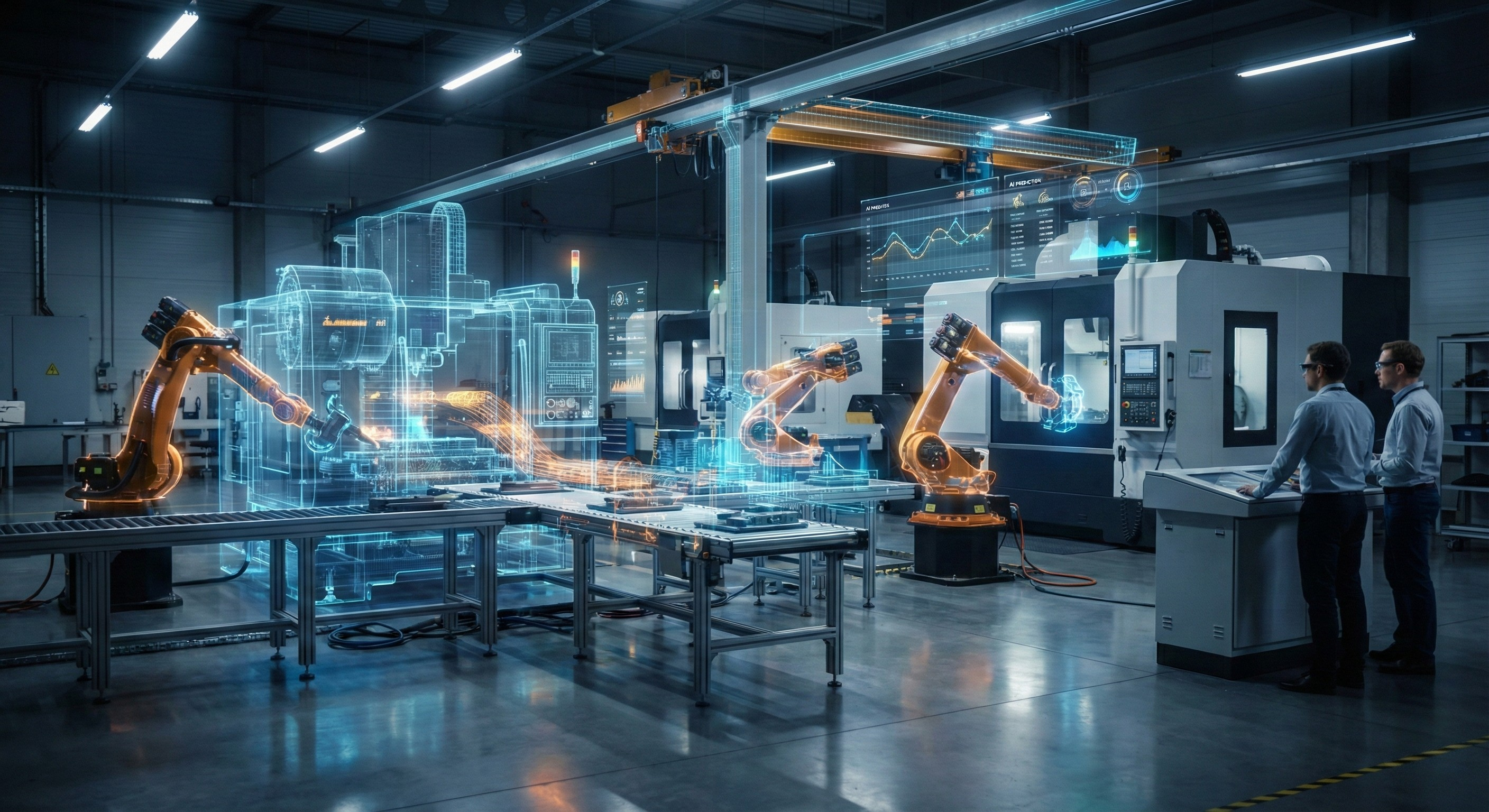
Digital twins originated from simulation systems used in engineering and design. These early models were static, offline, and disconnected from real operations. They helped engineers analyze performance, but they did not influence live production.
The transformation began when models became connected to real-time data streams.
This transition introduced several critical capabilities:
-
Continuous state updating
-
Model calibration using operational data
-
Predictive analysis during operation
-
Integration with control systems
The digital twin evolved from a passive analysis tool into an active operational system.
Historically, simulation answered the question:
“What would happen if this system behaved in a certain way?”
Modern digital twins answer a fundamentally different question:
“What is happening now, what will happen next, and what should the system do immediately?”
This shift represents the transition from simulation to operational infrastructure.
Today, the digital twin industrial AI stack is not separate from production. It is embedded within production.
Why Traditional Monitoring Cannot Provide Operational Intelligence
Most factories rely on monitoring systems such as SCADA, historians, and dashboards. These systems provide visibility, but visibility is not intelligence.
Monitoring systems can answer:
-
What happened
-
When it happened
-
Where it happened
But they cannot reliably answer:
-
Why it happened
-
What will happen next
-
What action should be taken
This limitation exists because monitoring systems observe surface signals without understanding internal system state.
Critical variables such as mechanical wear, friction, thermal stress, and structural deformation are not directly observable. These latent variables determine system behavior but cannot be inferred from telemetry alone.
Digital twins solve this problem by estimating internal state using physics-based models and data assimilation techniques.
This allows the system to infer:
-
Remaining useful life
-
Mechanical degradation
-
Process instability
-
Failure probability
Without a digital twin, industrial systems remain reactive.
With a digital twin, they become predictive and prescriptive.
How Digital Twins Unify Real-Time Sensor Data, Physics Models, and AI
Digital twins unify three essential sources of operational intelligence:
Real-time sensor data
Sensor data provides direct measurement of system behavior.
Examples include:
-
Temperature
-
Vibration
-
Pressure
-
Position
-
Current
-
Vision systems
This data provides ground truth.
Physics-based models
Physics-based digital twins simulate system behavior using physical laws.
These models capture relationships such as:
-
Thermal dynamics
-
Structural mechanics
-
Fluid dynamics
-
Motion dynamics
-
Energy transfer
Physics models enable extrapolation beyond observed data.
They allow the twin to estimate hidden internal variables.
AI and machine learning models
AI models detect patterns and anomalies that physics models alone cannot capture.
These include:
-
Complex nonlinear relationships
-
Manufacturing variability
-
Multi-variable correlations
-
Unknown system behaviors
AI provides adaptive intelligence.
Physics provides structural correctness.
Together, they create reliable operational intelligence.
Architecture: Real-Time Digital Twin Systems Explained
A real-time digital twin manufacturing architecture consists of several core layers.
Data acquisition layer
Collects sensor data, control signals, and events from machines and systems.
This layer ensures reliable and time-aligned data ingestion.
Synchronization layer
Maintains real-time alignment between physical and digital states.
This layer performs:
-
Time synchronization
-
State updates
-
Data validation
Real-time synchronization is essential for accuracy.
Model execution layer
Runs physics-based models and AI models continuously.
This layer produces:
-
State estimates
-
Predictions
-
Simulations
State estimation layer
Combines sensor data and model outputs to maintain accurate internal system state.
This enables inference of latent variables.
Decision layer
Evaluates operational objectives and constraints.
Generates optimal actions.
Examples include:
-
Adjust process parameters
-
Schedule maintenance
-
Prevent machine faults
Control and actuation layer
Executes decisions through control systems.
This closes the loop between digital and physical systems.
This closed-loop architecture transforms the digital twin into an operational execution system.
Role of Edge Computing in Real-Time Digital Twins
Edge computing integration is essential for real-time digital twin manufacturing systems.
Latency is the primary constraint.
If computation occurs too far from the physical system, decisions arrive too late to be useful.
Edge computing solves this problem by executing twin computation near the physical machines.
This enables:
-
Millisecond-level decision latency
-
High-frequency synchronization
-
Reliable operation during network disruptions
-
Reduced bandwidth usage
Edge systems host critical twin components such as:
-
State estimators
-
AI inference engines
-
Physics simulations
-
Control logic
Cloud systems remain useful for training, orchestration, and long-term optimization.
But real-time decision-making must occur at the edge.
Without edge computing, real-time digital twins cannot support autonomy.
How Digital Twins Enable Predictive Maintenance and Downtime Prevention
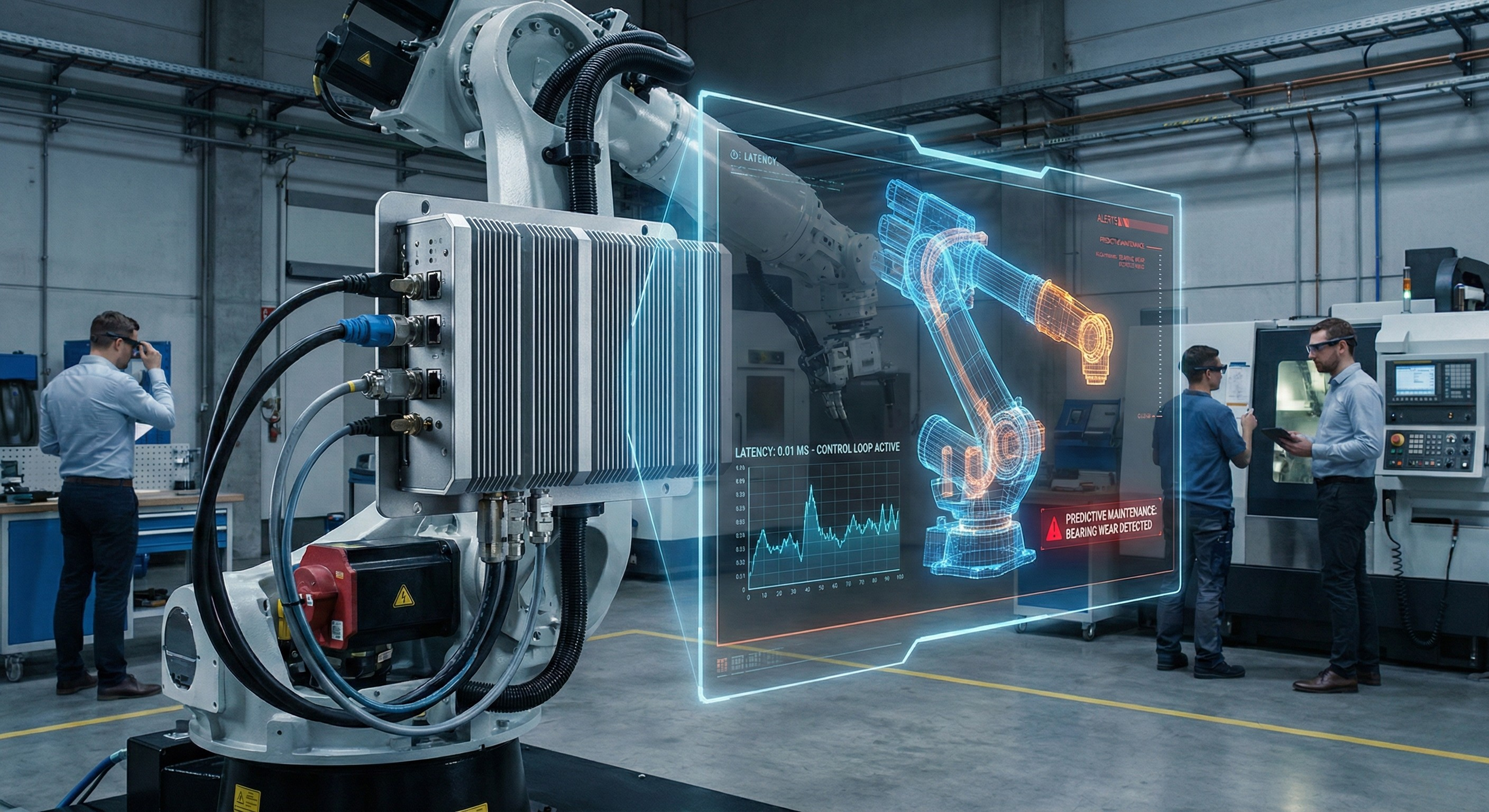
Predictive maintenance requires accurate estimation of system degradation.
Digital twins provide this capability by combining:
-
Real-time sensor data
-
Physics-based degradation models
-
AI anomaly detection
This allows the twin to detect failure precursors before failures occur.
Examples include:
-
Bearing wear detection
-
Tool degradation estimation
-
Thermal stress monitoring
-
Misalignment detection
The twin can simulate future system behavior under different operating conditions.
This enables optimal maintenance timing.
Instead of reactive maintenance, factories can perform predictive and prescriptive maintenance.
This prevents unplanned downtime and increases equipment availability.
Digital Twins as the Foundation of Autonomous Factories
Autonomous factories require systems that can operate independently.
This requires three essential capabilities:
Continuous operational awareness
The system must know the current state of all assets.
Digital twins provide this unified state representation.
Predictive intelligence
The system must predict future system behavior.
Digital twins simulate future outcomes.
Closed-loop control
The system must take action automatically.
Digital twins enable closed-loop systems that continuously adjust operations.
This transforms factories from reactive systems into autonomous systems.
The digital twin becomes the operational core.
How Digital Twins Enable Machine-Speed Decision Making
Machine-speed decision-making refers to decisions made at the timescale of physical processes.
These decisions occur faster than human reaction time.
Examples include:
-
Preventing machine collisions
-
Adjusting process parameters
-
Detecting anomalies instantly
-
Stabilizing unstable processes
Digital twins enable this by providing:
-
Real-time synchronized state
-
Predictive simulation capability
-
Immediate decision execution
This allows factories to operate safely and efficiently without human intervention.
The digital twin becomes the system responsible for maintaining operational stability.
FAQ
Overviews
What is an industrial digital twin?
An industrial digital twin is a real-time synchronized digital model of a physical industrial system used for monitoring, prediction, and control.
Why are digital twins important in manufacturing?
They enable predictive maintenance, operational optimization, and autonomous control.
What is real-time digital twin manufacturing?
It is the use of continuously synchronized digital twins to operate manufacturing systems in real time.
How do digital twins enable autonomous factories?
They provide real-time system awareness, predictive intelligence, and closed-loop decision-making.
Why is edge computing important for digital twins?
It enables low-latency computation required for real-time synchronization and control.
What are physics-based digital twins?
They use physical models to simulate real-world system behavior accurately.